
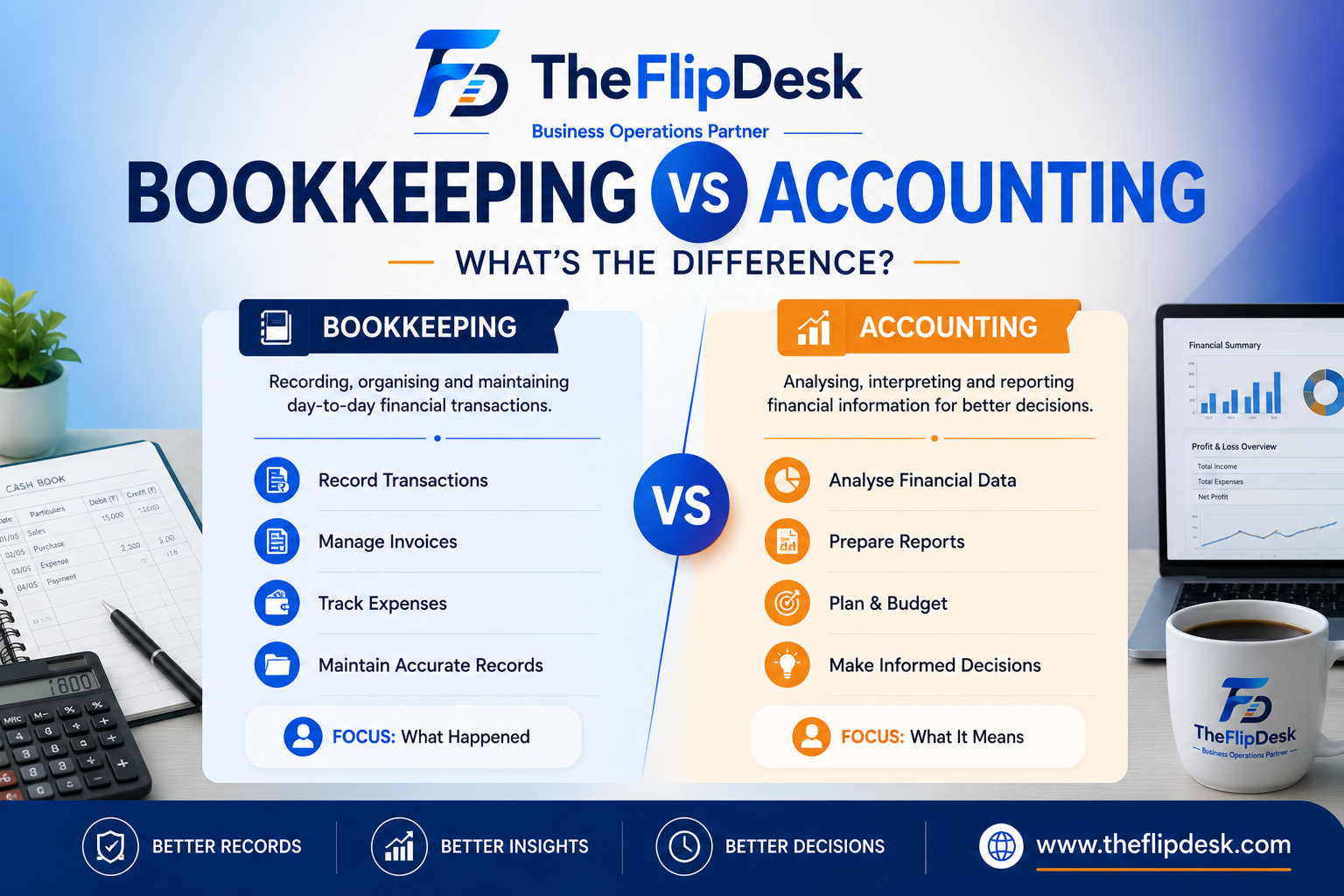
Bookkeeping vs Accounting: What Does Your Business Actually Need?
Running a business means keeping track of much more than sales and expenses.
Invoices need to be recorded. Payments need to be tracked. Expenses need to be organised. Financial records need to stay up to date.
This is where bookkeeping and accounting come in.
Although the two terms are often used interchangeably, they are not exactly the same.
Understanding the difference can help you decide what financial support your business actually needs.
What Is Bookkeeping?
Bookkeeping is primarily about recording and organising financial transactions.
A bookkeeper may handle routine activities such as:
- Recording sales
- Recording purchases
- Maintaining expense records
- Recording invoices
- Tracking payments
- Reconciling transactions
- Maintaining financial records
- Organising supporting documents
In simple terms:
Bookkeeping helps you keep your financial records organised and up to date.
For a growing business, good bookkeeping provides a reliable record of what has happened financially.
What Is Accounting?
Accounting goes beyond recording transactions.
It involves interpreting financial information and using it to understand the financial position and performance of a business.
Accounting activities may include:
- Reviewing financial records
- Preparing financial statements
- Analysing business performance
- Financial reporting
- Tax-related analysis and compliance work
- Budgeting and forecasting
- Supporting financial decisions
In simple terms:
Bookkeeping records the numbers. Accounting helps you understand what those numbers mean.
Bookkeeping vs Accounting: The Simple Difference
| Bookkeeping | Accounting |
|---|---|
| Records transactions | Analyses financial information |
| Maintains financial records | Interprets financial data |
| Tracks income and expenses | Reviews financial performance |
| Records invoices and payments | Supports financial reporting |
| More routine and ongoing | More analytical and advisory |
| Focuses on what happened | Helps understand what it means |
There is some overlap between the two, and the exact responsibilities can vary depending on the business and the professionals involved.
Why Does Bookkeeping Matter?
You don't need to be a large company to benefit from organised financial records.
Even a small business may have:
- Customer invoices
- Vendor bills
- Bank transactions
- Business expenses
- Employee or contractor payments
- Tax-related records
- Receivables and payables
When these records aren't maintained properly, it becomes harder to understand the actual financial position of the business.
Poor records can also make month-end review, reporting and tax-related work more difficult.
Why Does Accounting Matter?
Once financial information is properly recorded, the next question is:
What does it tell you about the business?
For example:
Your business may be generating ₹10 lakh in sales.
That sounds positive.
But if expenses have also increased significantly, your actual profitability may tell a different story.
Accounting helps turn financial data into information that can support business decisions.
It can help answer questions such as:
- Is the business actually profitable?
- Which expenses are increasing?
- Are customers paying on time?
- Is cash flow becoming a problem?
- Can the business afford to expand?
- Which areas of the business are performing well?
Does a Small Business Need Both?
Not necessarily in the same way or at the same level.
A small business may primarily need reliable bookkeeping and financial record management.
As the business grows, it may need more structured accounting, reporting, financial analysis and professional tax support.
The important thing is to identify what your business actually needs rather than paying for services you don't currently require.
When Should You Consider Bookkeeping Support?
Bookkeeping support may make sense when:
- You are spending too much time recording transactions
- Your invoices and expenses are not consistently organised
- Bank transactions aren't being reconciled regularly
- Financial records are falling behind
- You are preparing everything manually
- You struggle to locate financial documents
- You need better billing and payment tracking
For many small businesses, getting the bookkeeping process under control can be the first step toward better financial management.
When Do You Need Accounting Support?
You may need accounting or professional financial advice when you require:
- Financial statements
- Detailed financial analysis
- Tax planning or professional tax advice
- Business forecasting
- Complex financial reporting
- Support with specific compliance matters
- Strategic financial decision-making
It's important to distinguish bookkeeping support from regulated professional services. Depending on the work involved, you may need a qualified accountant or tax professional.
Can Bookkeeping Be Outsourced?
Yes.
Many businesses don't need a full-time employee dedicated to routine bookkeeping and billing administration.
Depending on the business, certain tasks can be handled through external support, particularly when the work is:
- Recurring
- Process-driven
- Remote
- Administrative in nature
- Clearly documented
Outsourcing can allow the business owner to maintain organised records without immediately building a larger internal finance team.
However, outsourcing doesn't mean handing over financial responsibility without controls.
Your business should still have:
- Clear processes
- Defined responsibilities
- Access controls
- Regular reviews
- Proper documentation
- Appropriate professional oversight where required
Bookkeeping vs Accounting: Which One Does Your Business Need?
Use this simple approach:
If your main problem is:
“Our financial records aren't organised.”
→ You may need bookkeeping support.
If your main problem is:
“We have the numbers, but we don't understand what they mean.”
→ You may need accounting and financial analysis.
If your problem is:
“We need professional tax, compliance or financial advice.”
→ You may need a qualified accountant or relevant professional.
And in some cases, your business may need a combination of all three.
How TheFlipDesk Can Help
At TheFlipDesk, our Finance & Billing support focuses on helping businesses manage the operational side of their financial administration.
Depending on your requirements, support can include:
- Invoice management
- Billing administration
- Bookkeeping support
- Expense record organisation
- Payment follow-ups
- Financial data organisation
- Routine finance administration
For specialised accounting, tax advice or statutory compliance, businesses should work with an appropriately qualified professional.
Our role is to help keep the day-to-day financial operations organised.
Better records. Better visibility. Better business decisions.
Need help with Finance & Billing?
[Talk to TheFlipDesk →]
Final Thought
Bookkeeping and accounting aren't competing alternatives.
They solve different problems.
Bookkeeping helps maintain accurate financial records. Accounting helps interpret and use that financial information.
For a growing business, the first step is often simple: make sure your financial records are organised, current and reliable.
Once the foundation is right, better financial decisions become much easier.
My recommendation for this article
Don't make the featured image overly complicated. Unlike the GST article, this one should visually communicate a comparison.
I'd create a TheFlipDesk-branded image with:
BOOKKEEPING vs ACCOUNTING
What's the difference?
Left side:
📒 Transactions | Invoices | Expenses | Records
Right side:
📊 Analysis | Reports | Planning | Decisions
Bottom:
Finance & Billing | www.theflipdesk.com