
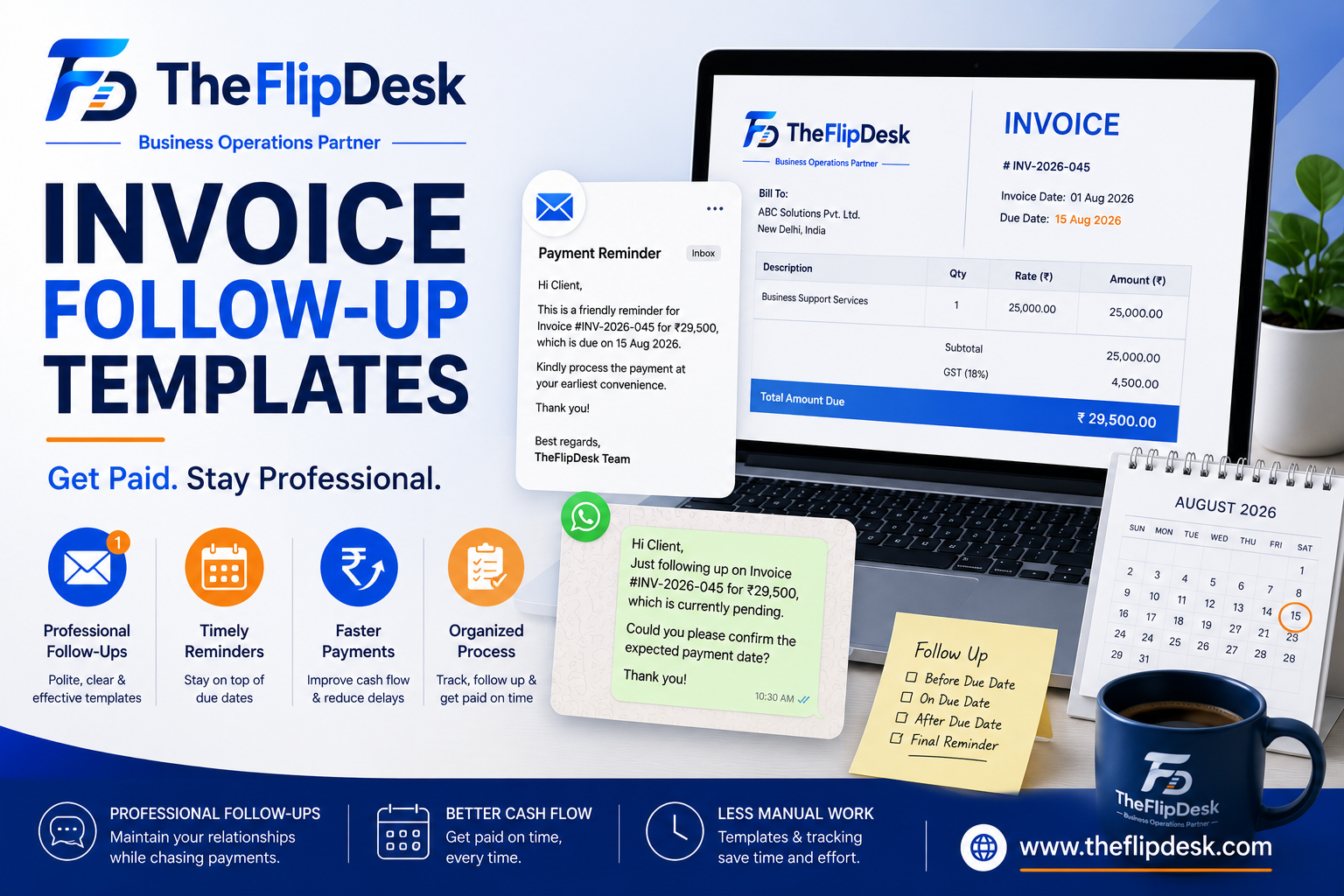
Invoice Follow-Up Templates That Get You Paid Faster
Sending an invoice is only the first step.
The real challenge for many businesses starts when the payment due date approaches — or passes — and you need to follow up with the customer.
You don't want to sound aggressive.
You also don't want your invoice to be forgotten.
A good payment follow-up should be clear, professional and appropriately timed.
Here are practical invoice follow-up templates you can adapt for email or WhatsApp.
Why Invoice Follow-Ups Matter
Late payments can affect a business even when sales are strong.
If customers don't pay on time, your business may face:
- Cash-flow pressure
- Difficulty paying suppliers
- Increased administrative work
- More time spent chasing payments
- Uncertainty about expected cash inflows
The solution isn't necessarily to send more reminders.
It's to create a consistent payment follow-up process.
When Should You Follow Up on an Invoice?
There isn't one perfect schedule for every business, but a simple process can look like this:
Before the due date:
Send a friendly reminder.
On or shortly after the due date:
Confirm whether payment has been scheduled.
A few days after the due date:
Send a clear overdue reminder.
After a longer delay:
Escalate the communication and request a specific payment date.
The exact timing should depend on your payment terms, customer relationship and internal policy.
Template 1: Friendly Reminder Before the Due Date
Use this when the invoice is approaching its due date.
Subject: Payment Reminder – Invoice #[Invoice Number]
Hi [Client Name],
Just a friendly reminder regarding Invoice #[Invoice Number] for [Amount], which is due on [Due Date].
Please let us know if the payment has already been scheduled.
Thank you for your continued support.
Best regards,
[Name]
[Company]
Template 2: Payment Due Today
Use this when the invoice reaches its due date.
Subject: Payment Due Today – Invoice #[Invoice Number]
Hi [Client Name],
This is a quick reminder that Invoice #[Invoice Number] for [Amount] is due today.
Please arrange the payment at your convenience and let us know once it has been processed.
Thank you.
Best regards,
[Name]
[Company]
Template 3: Invoice Is Overdue
When the payment has passed its due date, be polite but more direct.
Subject: Overdue Payment – Invoice #[Invoice Number]
Hi [Client Name],
I’m following up regarding Invoice #[Invoice Number] for [Amount], which was due on [Due Date] and is currently outstanding.
Could you please confirm the expected payment date?
If the payment has already been made, please share the payment details so we can update our records.
Thank you.
Best regards,
[Name]
[Company]
Template 4: Short WhatsApp Follow-Up
For clients who normally communicate through WhatsApp, keep it short.
Hi [Name], just following up on Invoice #[Invoice Number] for [Amount], which is currently pending. Could you please confirm the expected payment date? Thank you.
Don't send a long paragraph when a simple message will do.
Template 5: Second Follow-Up
If you've already sent one reminder and haven't received a response, make the next message more specific.
Subject: Second Follow-Up – Outstanding Invoice #[Invoice Number]
Hi [Client Name],
Following up again regarding Invoice #[Invoice Number] for [Amount], which remains outstanding.
Could you please confirm when we can expect the payment?
We would appreciate an update so that we can keep our accounts up to date.
Regards,
[Name]
[Company]
Template 6: Requesting a Specific Payment Date
Sometimes asking for "an update" isn't enough.
Ask for a specific date.
Hi [Name], regarding Invoice #[Invoice Number] for [Amount], could you please confirm the date by which the payment is expected to be processed? This will help us update our payment schedule accordingly. Thank you.
This is often more useful than repeatedly asking whether payment has been made.
Template 7: When the Client Says Payment Is Already Made
Don't keep chasing a customer who has already paid.
Instead, verify the transaction.
Subject: Payment Confirmation – Invoice #[Invoice Number]
Hi [Client Name],
Thank you for the update.
Could you please share the payment reference/transaction details so we can verify the payment and update our records?
Thank you.
Best regards,
[Name]
Template 8: Final Professional Reminder
For significantly overdue invoices, your communication should be firm without becoming unnecessarily confrontational.
Subject: Final Payment Reminder – Invoice #[Invoice Number]
Hi [Client Name],
This is a final reminder regarding Invoice #[Invoice Number] for [Amount], originally due on [Due Date].
The amount remains outstanding in our records.
Please arrange the payment or confirm the expected payment date by [Date].
If there is any issue with the invoice that needs to be resolved, please let us know so we can discuss it.
Regards,
[Name]
[Company]
5 Tips for Better Invoice Follow-Ups
1. Don't wait too long
A small delay can become a much bigger delay.
Start following up according to your agreed payment terms.
2. Keep the invoice details visible
Always mention:
- Invoice number
- Amount
- Due date
- Payment status
This makes it easier for the customer to identify the transaction.
3. Ask for a specific action
Instead of:
"Please check."
Try:
"Could you please confirm the expected payment date?"
A specific question is easier to answer.
4. Keep your tone professional
The objective is to collect payment without damaging a good business relationship.
Avoid emotional or accusatory language.
5. Maintain a payment follow-up record
Don't rely on memory.
Track:
| Invoice | Amount | Due Date | Last Follow-Up | Expected Payment | Status |
|---|---|---|---|---|---|
| INV-001 | ₹25,000 | 10 Aug | 11 Aug | 15 Aug | Pending |
| INV-002 | ₹18,500 | 08 Aug | 11 Aug | — | Overdue |
A simple tracking system can prevent invoices from being forgotten.
When Invoice Follow-Ups Become a Problem
If you are spending hours every week checking invoices, sending reminders and updating payment records, the problem may no longer be individual late payments.
It may be your billing process.
A better process can include:
Invoice issued → Due date tracked → Reminder scheduled → Payment confirmed → Records updated
This makes payment follow-up a process rather than something you remember to do manually.
How TheFlipDesk Can Help
At TheFlipDesk, our Finance & Billing support can help businesses organise the administrative side of their billing process.
Depending on your requirements, support can include:
- Invoice management
- Billing administration
- Payment follow-ups
- Receivables tracking
- Expense record organisation
- Financial data management
- Routine finance administration
The goal is simple:
Keep your billing organised so you spend less time chasing paperwork and more time running your business.
Need help with Finance & Billing?
[Talk to TheFlipDesk →]
Final Thought
Getting paid on time isn't only about sending invoices.
It's about having a consistent process for tracking invoices, communicating with customers and recording payments.
Use the templates above as a starting point, adjust the tone to suit your customer relationships, and most importantly, make payment follow-up part of your regular business process.
Good billing doesn't end when the invoice is sent. It ends when the payment is properly received and recorded.